Courses
Training courses for organizations
We provide evidence-based training on pain, its prevention, and management for organisations and healthcare professionals.
As all of our training courses are tailored to the specific needs of each organisation and target group, please include the intended audience, objectives, preferred duration, and any other relevant requirements when requesting a quote.
Explore the topics below:
Office work and musculoskeletal pain
The training covers:
- What is pain and how does it develop?
- Risk factors in office work – where does pain fit in?
- How does work-related pain develop?
- Which risk factors can we control, and which are beyond our control?
- How can pain be prevented in practice?
- The importance of physical activity in preventing pain among office workers
- When does office ergonomics matter, and when does it not?
- Common myths and misconceptions about work-related pain
The detailed training programme is tailored to the organisation’s specific context, needs, and the duration of the training.
Prevention of musculoskeletal injuries and pain in physically demanding work
The training covers:
- Risk factors in physically demanding work and pain
- Understanding overuse injuries
- Common causes of work-related injuries
- How can pain caused by overuse be prevented?
- What should be considered when manually handling loads and performing other physically demanding tasks?
- Practical assessment of workplace safety
- Practical warm-up exercises for physically demanding work
- Practical manual handling of loads
Pain Management for Healthcare Professionals
Healthcare professionals encounter patients with pain on a daily basis. Because pain management often receives relatively little attention in healthcare education and training, many professionals feel they need additional knowledge and practical skills to manage patients with pain more effectively.
The training covers:
- Modern Pain Theory and the Biopsychosocial Model of Pain
- A Crash Course in Pain Neurophysiology
- Biopsychosocial Factors Associated with Pain
- Factors Associated with Pain Prognosis and How to Identify Them from the Patient History
- Considering Pain-Related Factors in Treatment
- Developing a Treatment or Therapy Plan for a Patient with Pain
- Lifestyle Counselling for Patients with Pain
- Pain Education and Explaining Pain
The training includes practical exercises and case-based discussions. The detailed programme is tailored to the needs of the organisation and the target group, such as physicians, nurses, physiotherapists, and other healthcare professionals.
Workplace adjustment
A specialist can be invited to assess the workplace and recommend appropriate adaptations. This may include reviewing workplace ergonomics, advising on rest and movement breaks and their content, and providing personalised recommendations for employees. Following the assessment, a report is prepared summarising the findings and providing general recommendations.
We also offer preparation of the physiological risk factors section of workplace risk assessments.
Workplace adaptation can be booked either together with a training course or as a standalone service.
Public training courses for healthcare professionals
We provide public training courses for different specialists working in the healthcare sector
Below you can find information about upcoming public training courses.
Upcoming public training courses:
Chronic Pain Management for Physiotherapists and Occupational Therapists, 23–24 November 2026
Chronic Pain Management for Healthcare Professionals – How to Understand and Explain Pain? (November/December 2026, more information coming soon)
Would you like to be among the first to know when the next training course is announced? Email me at martin@valuvares.ee.
The prevalence of chronic pain continues to increase, and physiotherapists and occupational therapists are seeing a growing number of patients with persistent pain. Chronic pain is often managed using the same treatment approaches as other conditions, which can lead to less effective outcomes.
The aim of the training is to provide physiotherapists and occupational therapists with an up-to-date understanding of chronic pain management, from the neurophysiological mechanisms and different types and characteristics of chronic pain to practical methods for pain assessment, patient education, counselling, and therapy.
To ensure that participants gain the greatest possible benefit, the training is delivered over two days. This allows not only for a broader understanding of chronic pain, but also for the development of practical skills that can be applied in everyday clinical work. The training includes a substantial amount of group discussion, case analysis, practical exercises, and other interactive learning methods.
Learning outcomes:
- Understands the neurophysiological mechanisms of chronic pain and is able to differentiate between them.
- Is able to identify factors associated with a poor prognosis from the patient history and use the biopsychosocial model to assess and profile risk factors in patients with pain.
- Understands the different types of chronic pain, including mixed pain, and the risk factors for pain chronification.
- Is familiar with current methods for assessing patients with chronic pain.
- Is able to provide pain education and explain pain to people with chronic pain.
- Is able to provide physical activity counselling for patients with chronic pain.
- Is able to apply different methods for modifying therapeutic exercise in patients with pain.
- Knows which therapeutic approaches are effective and which are ineffective for different types of chronic pain.
Target audience: physiotherapists and occupational therapists – ennekõike need, kes ei ole veel saanud põhjalikumat kroonilise valu õpet.
Date & time: November 23-24, 2026. November 23th 10:00 - 18:00. November 24th 09:00 - 16:00
Place: Tallinn Health University of Applied Sciences (Kännu 67, Tallinn).
Price: 290 eur. Includes participation in the training, coffee and snack breaks, lunches, training materials, and a certificate of completion.
Members of the Estonian Association of Physiotherapists (EFL) are eligible for a discounted price 250 eur.
Register by filling out the form here.
If the course is fully booked but you are still interested, please get in touch! I can add you to the waiting list or notify you in advance about upcoming courses.
Please get in touch for more information. PS! This course is in Estonian!
Feedback from participants
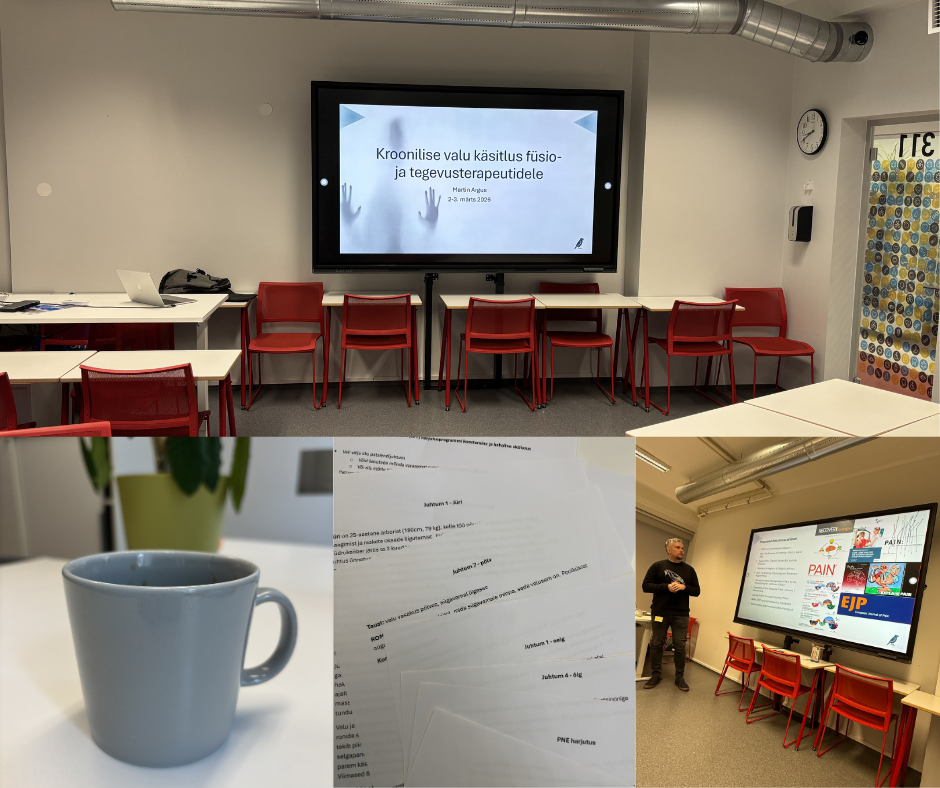
March 2-3. 2026, Tallinn
"Chronic Pain Management for Physiotherapists and Occupational Therapists"
100% of participants who responded to the feedback survey would recommend the training to a colleague!
“The overall structure of the training was excellent. Afternoon lectures often turn into a struggle to stay awake, but that was definitely not the case this time. In short, the topic was covered very well and the training was excellently structured. Thank you!”
“I especially liked the explanation of neurophysiology, the principles of pain education, the recommendations for home exercises, and the structured approach to assessment. I could listen to the neurophysiology part again and again, because when reading about it there are so many things that can be difficult to understand, but your explanations make it clear and genuinely fascinating.”
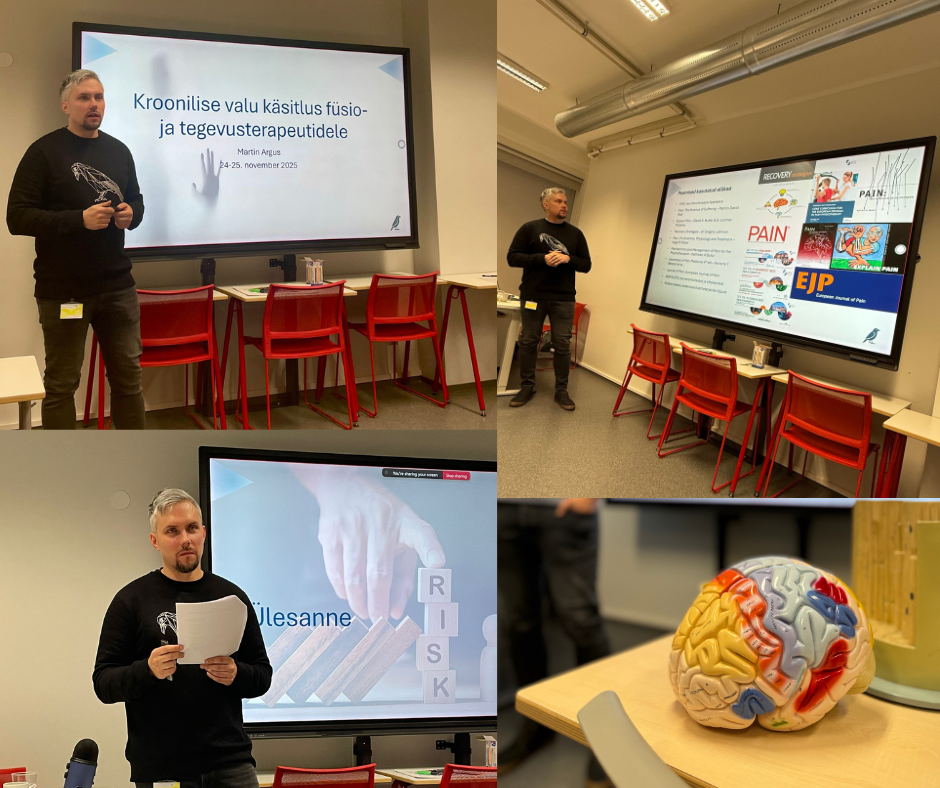
November 24-25th 2025, Tallinn
"Chronic Pain Management for Physiotherapists and Occupational Therapists"
100% of participants who responded to the feedback survey would recommend the training to a colleague!
“What I appreciated most was the educator’s experience in the field, sense of humour, and genuine understanding of physiotherapy practice. The practical exercises made a major difference in applying the knowledge. Without them, more than half of it would probably have been lost.”
“What I liked most was the practical value of the training and how it helps create a structured approach to addressing pain with clients.”
“The training was educational, thought-provoking, and sparked valuable discussion. It also reassured me that I am on the right track in my work, while showing me that there is still room to improve.”